
The ADHD Systems Behind My Six-Figure Private Practice
I like to pretend on the internet that I’m very type A.
I’m really just masking.
I’m a very type B mom of two little boys with ADHD. I like to think I have my life together, but that depends heavily on which day you ask me.
And yet, I run a smooth six-figure private practice.
Not because I finally became a naturally organized person.
I built systems around the places where I know I’m likely to get stuck.
That distinction matters.
A paper calendar did not create my revenue. Morning movement did not fill my caseload. Phone reminders did not set my fees or teach me how to build referral relationships.
These habits support the practice.
They help me remember where I need to be. They reduce scheduling mistakes. They protect my attention during sessions. They make it easier for me to follow through on the work that keeps the business moving.
My ADHD time management system includes five things.
I use more than one view of my calendar. I group client appointments into clear work blocks. I move my body before sessions. I use repeated opening and closing routines. And I build the practice around how I really function, not around the person I think I’m supposed to be.
This is what that looks like in real life.
Running a Private Practice Puts Pressure on More Than Your Clinical Skills
No one taught me in grad school how many small decisions I would make as a private practice owner.
There are client appointments, notes, consultations, emails, marketing tasks, bills, family commitments, school schedules, office supplies, continuing education, and about forty-seven browser tabs I swear I’m going to return to.
A private practice can look calm from the outside.
You sit in a quiet room. You see a client. You write a note. You go home.
That is not the whole job.
The National Institute of Mental Health includes difficulties with time management, planning, and organization among the challenges adults with ADHD may experience. Those challenges can become very visible when one person is responsible for both the clinical work and the business behind it.
That does not mean you don’t care enough.
It does not mean you’re careless, lazy, or bad at running a practice.
You can care deeply about your clients and still forget to check the calendar you closed three hours ago.
You can be an excellent therapist and still need three reminders before a meeting.
You can understand exactly what needs to happen and still struggle with getting started.
I spent too much time trying to become someone who remembered everything without support.
That person never arrived.
So I stopped waiting for her.
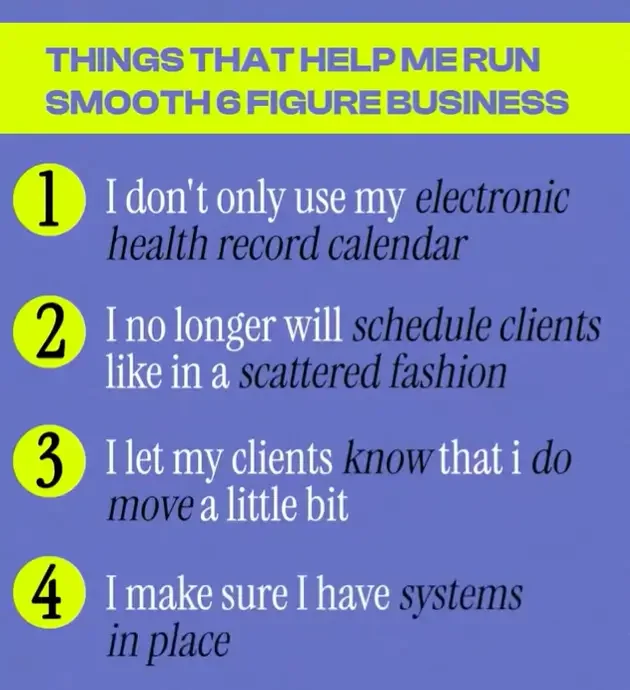
System 1. I Use More Than My Electronic Health Record Calendar
For years, I only used my SimplePractice calendar.
I still love it. I use it every day. I have even added personal events to it because I need to see what is happening around my client appointments.
But I learned that one digital calendar was not enough for my brain.
Somehow, I could still schedule a client when one of my kids had a school event. I could overlook an appointment because it was sitting quietly inside an app. I could plan two things too close together and only notice when I was already running late.
So I added a paper calendar.
Yes, a real paper calendar.
The kind you can hold, write on, and leave open on your desk.
My electronic calendar is the official schedule
My electronic health record holds the official client schedule.
That is where appointments are booked, changed, and confirmed. It is the version I treat as final when there is ever a difference between my systems.
The paper calendar gives me another way to see the same week.
It does not replace my electronic calendar. It gives my brain a wider view of what is coming.
When I look at a full week on paper, I can see that Tuesday is not simply a four-client day. It is a four-client day, a preschool pickup day, and the day I promised I would call the dentist.
That context changes how I plan.
My paper calendar gives the week a physical shape
Every week, I copy the commitments that matter onto paper.
I include client blocks, meetings, family commitments, appointments, writing time, and anything else that could affect where I need to be.
I do not write detailed client information on a personal calendar.
The United States Department of Health and Human Services explains that covered health care providers should take reasonable steps to limit protected health information to what is needed for the intended task. Your exact privacy duties will depend on your systems, professional rules, and location, so build your calendar process with those requirements in mind.
The point is not to create three complicated calendars.
The point is to help yourself see your actual life.
My phone remembers things before I have to.
I also set reminders on my phone for almost everything.
I know that sounds basic.
But sometimes basic is the thing that saves the day.
I may set one reminder before I need to start getting ready and another when I need to leave. For administrative tasks, I may set a reminder at the time I can actually do the work instead of the time the task first enters my head.
CHADD recommends planners and electronic reminders as practical tools for adults with ADHD. An app can send alerts through sound, email, or an on-screen message, while a paper planner can work well for people who need to see and write down their schedule.
The tool matters less than whether you will notice it and use it.
How I keep two calendars from becoming two different realities
Two calendars can create a new problem when neither one is kept current.
So I have one rule.
The electronic health record is the official source.
The paper calendar is a visual copy.
I update the paper version during a set weekly check. When something changes during the week, I change the official calendar first.
Then I update the paper version.
Without that rule, a second calendar becomes another place for information to disappear.
With it, the paper calendar becomes support instead of extra work.
System 2. I Group My Client Hours Instead of Scattering Them Everywhere
When I first opened my practice, I scheduled clients whenever they wanted to come.
Two clients in the morning.
A long lunch break.
One client in the afternoon.
Maybe another session later that evening.
It looked flexible on paper.
In real life, it was a mess for me.
I would see two clients, leave the office, go to Target, and forget that I needed to return.
I’m embarrassed to admit that.
But I also know I’m not the only therapist who has created a schedule that looked completely reasonable and then discovered that their brain did not agree.
Scattered appointments create too many restarts for me
Every break in the day asks me to switch roles.
Therapist.
Parent.
Shopper.
Business owner.
Therapist again.
The problem is not always the amount of work. Sometimes it is the number of times I have to stop and restart.
So I began grouping my client sessions into defined work periods.
When I have my work clothes on and I am already in therapist mode, I want to stay in that mode.
I do not want a four-hour gap in the middle of the day unless I have chosen that gap for a real reason.
What grouped client time looks like in my practice
On a client day, I may see six clients within one clear work block.
That number works for me.
It may not work for you.
When I say that I group clients together, I do not mean I race from one session into the next without breathing. I now protect 30 minutes between appointments, even though I used to leave only 15.
That time gives me room to finish a note, stand up, get water, use the bathroom, and settle before the next person walks in.
The work stays grouped.
The day still has breathing room.
Your nervous system gets a vote
Six clients is not a goal every therapist should copy.
Some therapists feel present and steady with six sessions. Others know that four is the point where their attention begins to fade.
Your schedule needs to protect the quality of your clinical work.
Look at when you feel focused, when you start rushing, and how long you need to reset between sessions. Then build around what you observe.
This is not about squeezing more people into a day.
It is about creating fewer unnecessary transitions.
System 3. I Move My Body Before I See Clients
I move a lot.
Even while recording a video, I shift in my chair. I change positions. My body seems to have its own schedule, and no one sent me a copy.
That movement can be distracting in a therapy session.
I do not want a client wondering whether I’m restless because of something they said or whether my movement means I’m not listening.
So I try to move my body before I begin seeing clients.
I am not talking about a punishing workout.
I have never been the person who wakes up excited to run ten miles before breakfast.
My goal is much simpler.
I need movement.
That may mean taking a walk, stretching, doing light strength work, or moving around the house before I sit down for several hours.
I notice a difference when I do it.
I feel more ready to sit with someone. I am less distracted by the urge to get up. My body has had a chance to wake up before I ask it to stay in one room and pay close attention.
Research gives us a cautious reason to keep exploring movement
A recent systematic review of exercise and adult ADHD found possible benefits from a single exercise session for some executive functions and ADHD symptoms. The findings for ongoing exercise programs were mixed.
That is why I describe movement as one of my personal support systems.
I am not presenting it as a cure.
I am not saying a morning walk replaces ADHD treatment, medication, therapy, coaching, or any other care that is right for you.
I am saying that movement helps me enter my workday with more steadiness.
Sometimes I explain my movement to clients.
Many of my clients know I have ADHD. Not all of them do.
I also have an old knee injury, which means I sometimes fold and unfold my legs during a session.
When I think the movement could be misunderstood, I may give a client a simple heads-up.
I might explain that I change positions because of my knee and that the movement does not mean I am distracted or uninterested.
That small explanation can remove a story the client might otherwise have to create on their own.
You do not need to disclose an ADHD diagnosis to every client.
The question is whether there is something happening in the room that could affect how a client reads your attention and whether a brief explanation would support the work.
System 4. I Use the Same Cues to Start and End My Day
I used to think a system needed to be impressive before it counted.
It does not.
Some of my most helpful systems are almost boring.
I turn on the office lights in the same way.
I sit down with the same kind of coffee.
I open the same programs.
I review the calendar.
I prepare for the first client.
These repeated cues tell my brain that the workday has started.
Small routines remove small decisions
I can lose a surprising amount of time trying to decide what to do first.
Should I check email?
Should I finish a note?
Should I look at the schedule?
Should I make coffee first?
And suddenly, I have spent 20 minutes doing none of those things.
An opening routine removes that negotiation.
My routine may include the following steps.
Turn on the office lights.
Put my water and coffee on the desk.
Open the official calendar.
Review the first client appointment.
Check that I have what I need for the session.
Set the reminder for the next transition.
The exact items are not important.
The repetition is what helps me.
My closing routine protects tomorrow
I also need a clear end to the day.
Otherwise, unfinished tasks follow me home as vague thoughts.
I know I need to do something.
I just cannot remember what the thing was.
Before I leave, I check whether my notes are complete, review the next workday, write down anything unfinished, and reset the office.
Tomorrow, I should not have to investigate what I was doing today.
This is also why I believe so strongly in giving therapists a clear sequence for the business side of private practice.
The Private Practice Roadmap breaks opening a practice into clear steps, so you know what comes next. I built it for the therapist who is trying to remember twelve business tasks while also doing clinical work and living a real life.
You do not need to hold the whole business in your head.
You need a place to find the next step.
System 5. I Design the Practice Around How I Actually Work
This may be the most important system.
I stopped building my schedule around an imaginary version of myself.
Imaginary Kelley remembers every appointment.
She enjoys open space between sessions.
She can leave the office for three hours and return at exactly the right time.
She has never once wandered into Target and forgotten the rest of the day.
Real Kelley needs reminders, visible plans, fewer transitions, movement, and repeated routines.
So that is what the practice gets.
I look for the place where things keep breaking down
When a problem repeats, I try not to turn it into a character judgment.
I study it.
Where does it happen?
What happened right before it?
What information was missing?
What would have made the next action easier to see?
Maybe you keep missing commitments because they live in different calendars.
Maybe your notes pile up because there is no protected time after sessions.
Maybe marketing only happens when your caseload gets quiet because it has no place in the weekly schedule.
Maybe every morning begins with 30 minutes of trying to decide what deserves your attention.
The repeated problem is information.
It shows you where support is missing.
I add one support around that point
I do not try to rebuild my entire life in one weekend.
I choose one point of friction and create one response.
If I miss transitions, I add an alarm.
If I forget family commitments, I add them to the weekly calendar review.
If I struggle to restart work, I group similar tasks together.
If I delay notes, I protect time before I leave the office.
Researchers have tested structured approaches that teach adults with ADHD skills for time management, planning, and organization. One randomized clinical trial of metacognitive therapy found improvements in ADHD symptoms and organizational skills after a program built around these areas.
That does not mean you need a perfect system.
It means these skills can be practiced with structure and support.
These habits support my six-figure practice.
I want to be very clear about the money part.
These habits did not cause my practice to become a six-figure business.
A calendar cannot bring in a client.
A reminder cannot decide what fee supports your life.
An opening routine cannot explain why someone should choose you.
These systems protect my ability to do the work consistently.
They help me show up for appointments. They make my schedule easier to manage. They reduce avoidable mistakes. They give me more room to focus on clients instead of trying to remember everything around them.
Revenue depends on more than personal organization.
It depends on your fees, the number of clients you can responsibly see, your expenses, how often clients attend, your services, and whether the people who need your work can find you.
A steady schedule still needs a path for clients
You can create the most beautiful calendar in the world and still have empty appointment times.
That is a different problem.
Marketing is how the right people learn that your practice exists, understand who you help, and decide whether reaching out feels right.
Inside Marketing for Therapists, I teach the client-facing side of the business. We work through clear messaging, referral relationships, therapist directories, websites, local visibility, and the places where therapists often get stuck.
You do not need to be everywhere.
You need to say the right things in the places your clients and referral sources are already looking.
Support matters when you are building alone.
A system can look good on paper and still fall apart when it meets your real week.
That is where conversation matters.
Inside The Private Practice Club, therapists bring in the questions they are dealing with right now.
Sometimes the question is about fees.
Sometimes it is about finding clients.
Sometimes it is about creating a schedule that does not make them resent the practice they worked so hard to build.
Another therapist often hears the question and says, “I have been stuck on that exact same thing.”
That moment matters.
You do not have to figure this out alone.
A Seven-Day ADHD Time Management Reset
You do not need to change your whole practice this week.
Start with seven small steps.
Day 1: Find every calendar you are using.
Check your electronic health record, phone calendar, paper planner, email, and any other place where appointments live.
Look for conflicts and missing commitments.
Day 2. Choose one official calendar.
Decide which calendar holds the final version of your schedule.
Every other calendar should support that source, not compete with it.
Day 3: Add useful reminders.
Choose one commitment you often forget.
Set one reminder for preparation and another for action.
Day 4. Look at the shape of your client week.
Find sessions that are scattered across long stretches of time.
Ask whether grouping some of them would reduce unnecessary transitions.
Day 5. Create a short opening routine.
Choose three actions that tell your brain the workday is beginning.
Keep them simple enough to repeat.
Day 6: Create a closing routine.
Check your notes, review tomorrow, record unfinished work, and reset the space.
Give tomorrow a clean starting point.
Day 7. Keep what helped
Do not keep a system because it looks organized.
Keep it because it makes your day easier to understand and your commitments easier to meet.
You Do Not Need to Become a Different Person
I used to think running a successful practice meant becoming more type A.
It did not.
I needed to understand where my brain needed support and stop feeling embarrassed about using it.
My paper calendar is not evidence that I failed at digital planning.
My reminders are not evidence that I cannot be trusted.
My grouped schedule is not evidence that I lack flexibility.
They are tools that help me protect my work, my clients, my family, and my attention.
Your private practice does not need to look organized from the outside.
It needs to work for the person running it.
And that person is allowed to need a plan.
Frequently Asked Questions
Can a therapist with ADHD run a successful private practice?
Yes. ADHD may affect planning, organization, attention, and time management, but it does not decide whether someone can be a skilled clinician or business owner. The National Institute of Mental Health explains that treatment and behavioral support can help adults manage symptoms and daily challenges.
What calendar system works best for a private practice owner with ADHD?
There is no single calendar system that works for everyone. I recommend choosing one official calendar, adding reminders you will notice, and using a paper view when physically seeing the week helps you understand it. CHADD’s planner guidance also encourages people to choose a format that fits how they naturally record and review information.
Is it better to schedule clients back-to-back when you have ADHD?
Grouped client blocks reduce transitions for me, but long clinical blocks can be tiring for another therapist. Build the schedule around the number of sessions you can hold while staying attentive, emotionally present, and able to complete the work around each appointment.
Does exercise improve ADHD productivity?
Research suggests a single exercise session may help some parts of executive functioning in adults with ADHD, while evidence for longer exercise programs remains mixed. The systematic review on adult ADHD and exercise supports treating movement as one possible support, not as a cure or replacement for professional care.
How do these systems help a private practice reach six figures?
They support consistency by reducing missed commitments, scattered work time, and preventable scheduling problems. Reaching a revenue level still depends on your fees, client capacity, expenses, demand, retention, referral relationships, and the way clients find your practice.