
How to Confidently Raise Your Therapy Fees in 2026 (Even When Things Feel Unpredictable)
Let me ask you something, and I want you to answer it honestly.
When did you last raise your therapy fee?
If your answer is "it's been a while," or "I'm not sure," or and I say this with so much love "I've never actually raised it," you are not alone. Fee-setting is one of the most emotionally loaded parts of running a private practice, and raising your fee is the part most therapists avoid the longest.
I remember the first time I raised my fee. I was convinced every single client I had was going to leave. I told myself they couldn't afford it. I told myself it wasn't the right time. I told myself I should wait until I had more experience, more credentials, more something. And then I finally did it, and almost everyone stayed. And I realized something that changed how I thought about this work entirely: valuing my own time actually helped me show up better for the people I serve.
That's what this blog is about. Not just the how, though we're covering all of that, including scripts, but the why, the mindset, the math, and the practical steps that make raising your fee feel like a professional decision instead of a personal crisis.
Because here's the thing: if you haven't raised your fee in the last year or two, you're effectively making less than you were before. And that's worth talking about honestly.
Why Raising Your Therapy Fees in 2026 Is More Important Than Ever
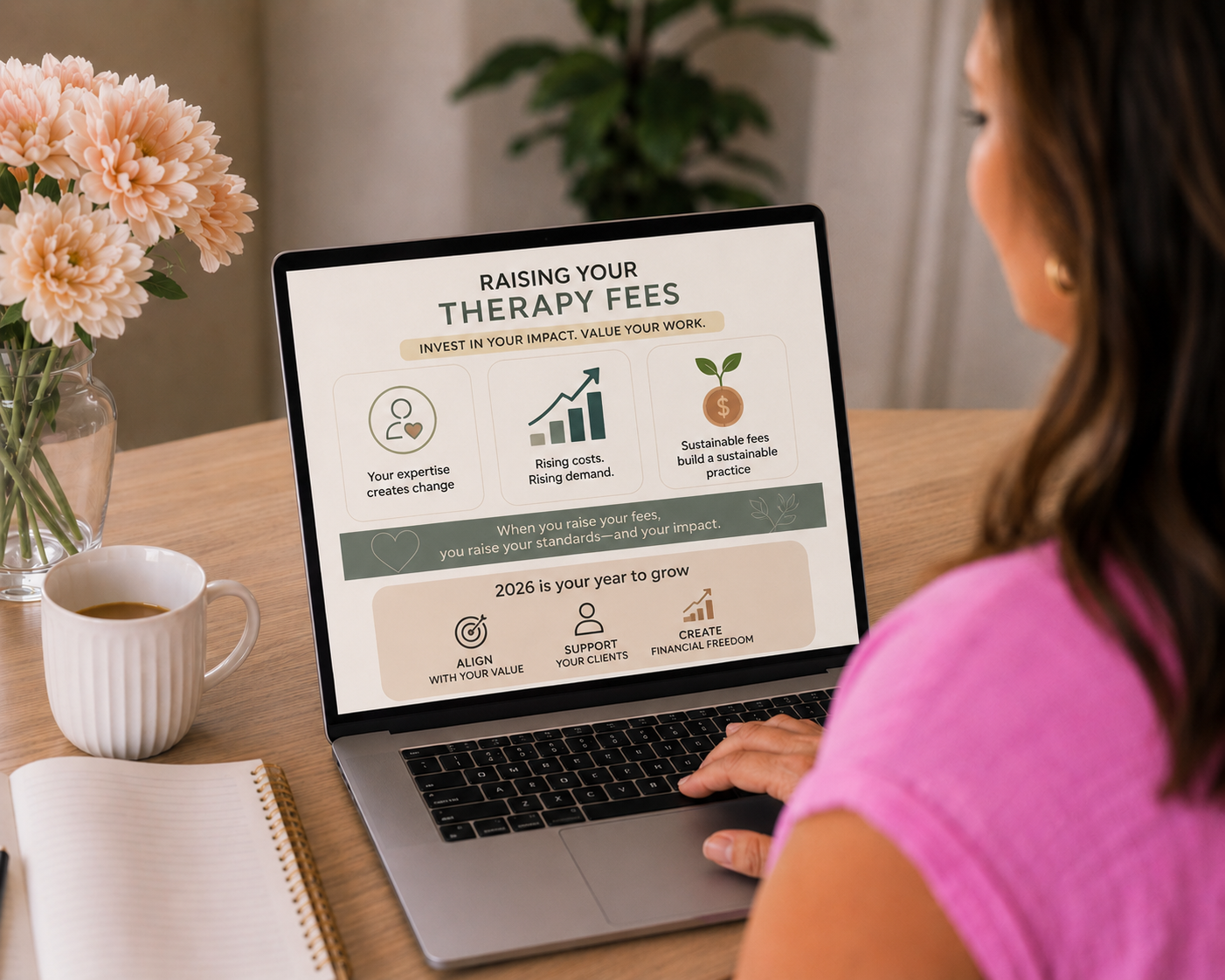
Let's start with the practical reality before we get into the feelings, because I think sometimes therapists need permission to look at this as a business decision before they can deal with the emotional layer underneath it.
Inflation is real, and it has hit private practice hard. Your rent went up. Your liability insurance went up. Your EHR subscription went up. The consultation you pay for went up. Continuing education went up. Everything that it costs to run a sustainable, ethical private practice has increased, and if your fee hasn't moved in two or three years, you are absorbing all of that increase yourself, silently, at the expense of your own financial well-being.
That's not noble. That's a problem.
Your clients expect fee increases more than you think. Here's something I see come up over and over again in The Private Practice Club community: therapists who are terrified to raise their fees discover, after they do it, that their clients barely flinch. Most clients understand that professional fees increase over time. They see it with their doctors. They see it with their dentists. They see it with every service provider in their life. The discomfort is almost always more intense on the therapist's side than the client's, and that asymmetry is worth paying attention to.
A financially sustainable practice serves your clients better. This isn't a guilt trip. It's just true. When you're financially stressed, it shows up in your work. When you're seeing more clients than you can realistically hold because your fee is too low to meet your income needs at a reasonable caseload, the quality of your presence suffers. Fee increases aren't just about you. They're about creating a practice that allows you to keep showing up fully for years, not just for the next few months before you burn out.
The cost of waiting compounds. This is the one that gets me most. A $10 or $15 increase this year is something most clients can absorb without much difficulty. A $40 or $50 increase four years from now because you've been avoiding this conversation for as long as possible is genuinely harder. Every year you delay, the gap between your current fee and your appropriate fee grows. And so does the awkwardness of addressing it.
Before We Talk Strategy: Your Relationship With Money Matters Here
I want to pause on the mindset piece before we get into scripts and worksheets, because I think it's the piece that actually determines whether any of this sticks.
Most therapists who struggle with fee-setting aren't struggling because they don't understand the math. They're struggling because they have deeply held beliefs about money, about worthiness, about what it means to charge for care, and those beliefs are running the show underneath the surface.
So before you read the rest of this, I'd invite you to sit with a few questions:
What messages did you grow up hearing about money? Were you taught that wanting more of it was greedy? Are people who charge a lot taking advantage of others? Should good work be its own reward? A lot of therapists choose this field specifically because they're helpers, and helpers are often socialized to minimize their own needs in the service of others. That wiring doesn't disappear when you open a private practice.
When you think about raising your fee, what feelings come up, and where do you feel them in your body? This is a therapy question, I know. But it's a useful one. Anxiety in your chest. Tightness in your throat when you imagine telling a long-term client their fee is going up. That's information. It's not a stop sign. It's just something worth noticing.
Are you assuming your clients can't afford more, or are you projecting your own financial anxiety onto them? This one is hard. But I've watched therapists with significant financial scarcity of their own assume their clients share that experience when actually, they don't know. They're guessing. And the guess is shaped more by their own money story than by anything their clients have actually told them.
What would change in your life and practice if money felt less stressful? Really sit with this one. Because for most therapists, the answer is significant. More bandwidth to give in sessions. The ability to take a real vacation. Fewer clients with more depth. A practice that actually feels like the one you imagined building.
Here's what I want you to take from this section: your fee is not just a number. It is a reflection of what you believe you deserve. And changing that number often requires doing some real work on what you believe.
How to Actually Calculate a Value-Aligned Therapy Fee
Okay. Let's do math. I promise it's not scary.
One of the things I see most often in private practice, and something I heard a lot when I was doing billing work for therapists, is that therapists set their fees based on what they see other therapists charging in their area. Which is understandable. But it's also a problem, because what other therapists charge is not the same as what you specifically need to charge to run a financially healthy practice.
Here's a simple formula that gives you a real starting point:
(Your annual income goal + your annual business expenses) ÷ (clients per week × working weeks per year) = your minimum session fee
Let's walk through a real example.
Say you want to bring home $80,000 per year. Your annual business expenses: rent, liability insurance, EHR, consultation, continuing education, and taxes total around $15,000. You want to see 20 clients per week, and you're planning to actually work 46 weeks per year (because you're going to take a vacation, you're going to get sick once or twice, and you're going to attend a training or two).
The math looks like this: ($80,000 + $15,000) ÷ (20 × 46) = $95,000 ÷ 920 = $103.26 per session.
That's the floor. That's the absolute minimum you need to charge, at that caseload, to meet those goals. And that doesn't include any buffer for slow months, any savings, or any investments back into your practice or your professional development.
Now write down your current fee next to that number.
If there's a gap, that's your answer. That's not a judgment. That's just information, and information is useful.
A few things to consider as you do this math for yourself:
Be honest about how many weeks you actually work. Most therapists significantly underestimate the weeks they'll take off in a year and then feel behind on their income goals because their math was based on 52 weeks of a full caseload.
Include taxes as an expense. If you're a solo practitioner paying self-employment tax, somewhere between 25-30% of your income is going to taxes. That has to be in your numbers.
Factor in your actual ideal caseload, not your maximum. There's a meaningful difference between the number of clients you could theoretically see and the number that allows you to do your best clinical work and still have a life.
The Small Increase Strategy: Why Raising Your Fee a Little Each Year Beats a Big Increase Every Few Years
This is the piece of advice I give most often, and the one I think makes the biggest practical difference for private practice therapists.
Instead of raising your fee dramatically every five or six years which feels like a big deal, creates a hard conversation, and requires a significant jump that clients can feel raise it a small amount every single year. Somewhere between $10 and $20 per session is typically where I land, and it's what I've done consistently in my own practice.
Here's why this approach works so well:
Small, predictable increases are easier for clients to absorb. A $15 increase is genuinely not difficult for most clients to accommodate with a little budget adjustment. A $50 increase after years of the same rate feels like a shock, even if the underlying math is identical.
Clients come to expect it, which means it's never a surprise. When you raise your fee every January, your clients learn that this is a normal part of working with you. After the first year or two, they're often already anticipating it. The conversation goes from "I have some difficult news" to "just a heads up, as I do every January, my fee is increasing next month."
You stay ahead of inflation instead of playing catch-up. Small annual increases track with the actual cost of living. Large, infrequent increases are always a reaction to falling behind. Annual increases are proactive.
It normalizes fee increases as a standard professional practice. When raising your fee is something you do every year, it stops being a big emotional event and starts being one of the administrative tasks of running a business. That shift in how you hold it as routine rather than fraught makes it dramatically easier over time.
On timing: pick a consistent date and stick to it. January 1st is common, and it's what I use in my own practice. But you could also align it with your license renewal, your business anniversary, or the start of a new fiscal quarter. What matters more than the specific date is the consistency. When your clients can predict when to expect it, the notification feels like a courtesy rather than a disruption.
On notice: give clients at least 30 days. Many therapists give 60. Put it in writing, whether that's through your client portal, an email, or both, and mention it verbally in session as well. Never let a client find out at the register, so to speak.
Exactly What to Say: Scripts for Communicating a Fee Increase
This is the part most therapists want most, so let's get into it.
The through-line for all of these scripts is this: state the increase clearly, give the reason briefly and without over-explaining, give the date, and leave space for questions without inviting a negotiation.
In-session announcement:
"I want to let you know that starting [month], my session fee will be increasing from [current fee] to [new fee]. I raise my fee yearly to reflect the cost of running my practice and to continue investing in my training and professional development. This change will take effect on [date]. If you have any questions or concerns, I'm happy to talk through them with you."
That's it. You don't need to apologize. You don't need to defend it. State it clearly, give the reason simply, and move on.
Written notice via email or client portal:
"Hi [client name], I wanted to give you advance notice that my session fee will be increasing to [new fee] beginning [date]. I review and adjust my fees annually to keep my practice financially sustainable and to continue providing high-quality care. Your current fee of [current fee] will remain in place through [last date at old fee]. Please don't hesitate to reach out if you'd like to discuss this."
Clean, professional, warm. Not an apology. Not a novel. Just the information they need.
When a new client asks about your fee:
"I charge [fee] for a 50-minute session. I accept credit and debit cards, and payment is due at the time of the appointment. I don't bill insurance directly, but I provide a monthly superbill that you can submit to your insurance company for possible out-of-network reimbursement."
State it confidently. Don't qualify it. Don't immediately offer a lower rate before they've even reacted. Just say the number and let it land.
When a client pushes back:
This is the one therapists lose sleep over. Here's what I want you to know: a client expressing difficulty with a fee increase is not the same as a client leaving. Most of the time, it's a client who needs a moment to feel heard before they figure out how to make it work.
"I understand that a fee increase can feel like a lot, and I really appreciate you being honest with me about that. I want to make sure we can find a way to continue our work together. Would it help to talk through what options might work for your situation?"
This opens a conversation without immediately capitulating. Sometimes the right outcome is a payment plan. Sometimes it's a brief pause in frequency. Sometimes the client figures it out, and the conversation ends there. But starting from a place of curiosity rather than guilt gives you the most options.
Why You Should List Your Fee on Your Website (And What's Really Behind the Fear of Doing It)
I'm going to say something that might make you a little uncomfortable: if your therapy fee isn't on your website, it's worth asking yourself why.
The most common answer I hear is some version of "I don't want to scare potential clients away." And I understand that. But here's what's actually happening when your fee isn't listed:
Potential clients who care about transparency will go somewhere else. Someone comparing therapists, which is almost everyone who's looking, is going to choose the one who makes the process easy. Listing your fee says, "I'm confident in what I charge, and I respect your time enough to make this information easy to find." Not listing it makes people work harder, which introduces friction that some of them won't bother pushing through.
It filters your inquiries in a way that saves everyone time and energy. If someone can't afford your fee, you'd rather they know that before a consultation call, not 20 minutes into one. The clients who self-select out based on your listed fee were never going to be a sustainable fit anyway. The ones who reach out knowing what you charge are already pre-qualified.
It positions you as a professional who is sure of their value. There's something subtly powerful about listing your fee without qualification. It communicates, even before a client meets you, that you know what your expertise is worth and you're not embarrassed by it.
Here's what the fear of listing your fee is often really about: scarcity. A belief, somewhere underneath the surface, that there aren't enough clients who can and will pay your rate, so you need to keep them in the conversation as long as possible before you risk losing them. That fear is almost never based on actual market data. It's based in a money story. And it's worth looking at.
What to Do When the Guilt Creeps In
Here's something I want to normalize: you can know all of this logically: the math, the scripts, the strategy, and still feel guilty when it's time to actually do it. That's not a failure. That's just what happens when you're a person with feelings who chose a profession built on caring for others.
Guilt about charging for your work is almost always about your own money story, not about your client's actual ability to pay. It's worth repeating: your discomfort with your fee is almost never an accurate reflection of your client's financial reality.
A few anchor statements to come back to when the guilt shows up:
"My fee reflects the value of my training, my experience, and my ability to hold space for people in some of the hardest moments of their lives."
"A sustainable practice allows me to keep doing this work for years to come. Burning out doesn't serve my clients."
"I can be deeply compassionate and well-compensated at the same time. These are not in conflict."
"Raising my fee is not taking something from my clients. It's making sure I can keep showing up for them."
On sliding scale: if you offer sliding scale slots, I encourage you to be genuinely intentional about them. How many spots? At what minimum? For how long? A sliding scale that isn't bounded tends to expand, and over time, it can become your default fee because you're uncomfortable stating your full fee with confidence. Reserve your sliding scale spots the way you'd reserve any limited resource: with thought, with criteria, and with a limit.
Your Private Practice Fee Increase Checklist
Let's make this actionable. Here's exactly what to do and when:
This week:
Run your numbers using the formula above and calculate your minimum session fee
Decide what your new fee will be (remembering that $10-20 annual increases are sustainable and effective)
Pick your increase date at least 30 days from now, ideally 60
This month:
Update your practice policies to include a fee review statement: "Fees are reviewed and adjusted annually. Clients are notified of any change a minimum of 30 days in advance."
List your fee on your website if it isn't already
Update your Psychology Today profile and any other directories
Choose your script and personalize it so it sounds like you
30 days before your increase date:
Notify current clients verbally in session
Follow up with written notice via your client portal or email
Update your intake documents if your fee is listed there
On increase date:
Implement the new fee in your EHR
Take a breath. You did the thing.
Common Mistakes to Avoid
A few patterns I see come up repeatedly when therapists finally do raise their fees:
Waiting until you're desperate or resentful. The best time to raise your fee is before you need to. When you're raising it from a place of burnout or financial panic, the emotional weight is much heavier. Annual small increases done proactively feel completely different from a crisis response.
Raising your fee and then immediately offering a discount. You gave yourself the increase and then took it back because someone seemed hesitant. I understand the impulse. But this teaches your clients that your stated fee is negotiable, and it teaches you that you don't actually believe in the number you just said.
Apologizing for your fee. You can be warm and matter-of-fact at the same time. "I'm so sorry, I know it's a lot, I feel terrible about this" is not a professional communication about a business decision. State it clearly, with warmth, and let your client respond.
Not updating every place your fee is listed. Your website, your Psychology Today profile, your Simple Practice or EHR settings, your intake documents, and your voicemail if it mentions your fee, all of it needs to be updated. Inconsistency creates confusion and undermines your credibility.
You Deserve to Build a Practice That Actually Sustains You

Here's the thing I really want you to hear as we wrap this up:
Raising your fee is not a betrayal of your values. It is not evidence that you've become too corporate or too focused on money or less committed to your clients. It is evidence that you understand something essential about sustainable practice: you cannot pour from an empty cup, and a practice that doesn't pay you a living wage will not last.
The practices I watched thrive in all my years doing billing work, and in all the years since building The Private Practice Pro, were the ones where the therapist believed they deserved to be compensated fairly. That belief showed up everywhere. In their fee, yes. But also in their boundaries, their energy, their presence, and the quality of the care they gave.
You deserve to build a life and practice you actually love. And a fee that actually reflects your value is one of the most concrete ways to start.
You've got this, and I've got you.
❤️ Kelley
Want to Go Even Deeper on This?
Inside The Private Practice Club, you get access to my fee-setting workbook and training, live bi-weekly Q&A calls where you can ask your specific questions in real time, done-for-you scripts for navigating difficult money conversations, and a supportive community of therapists building their practices together.
You don’t have to figure this out alone.
👉 Join The Private Practice Club here
Kelley Stevens is a licensed therapist and private practice coach at The Private Practice Pro. She helps therapists build financially sustainable, values-aligned private practices through coaching, courses, and community. Learn more at theprivatepracticepro.com.
Affiliate disclosure: Some links in this post may be affiliate links. I only recommend tools and services I genuinely use and believe in.
Frequently Asked Questions
How often should therapists raise their fees?
Many private practice therapists review their fees once a year. A consistent annual review helps your rates keep pace with rising business expenses and reduces the need for a large increase later.
How much should a therapist raise their fee?
A fee increase of $10 to $20 per session may be easier for clients to absorb than a larger increase every few years. However, the right amount should reflect your income goals, expenses, caseload, experience, and local market.
How do I calculate the right therapy fee?
Add your desired annual income to your estimated annual business expenses. Divide that total by the number of sessions you realistically expect to provide during the year. The result gives you a minimum fee to consider.
How much notice should I give clients before raising my fee?
Give clients at least 30 days of notice. Some therapists provide 60 days so clients have more time to prepare, ask questions, or adjust their session frequency.
Should I tell clients about a fee increase in person or by email?
Whenever possible, discuss the increase during a session and follow up with a written notice through email or your client portal. Written communication creates clarity and gives clients a record of the new fee and effective date.
Do I need to explain why I am raising my therapy fee?
You can provide a brief professional explanation, such as increased practice expenses, continued training, or an annual fee review. Avoid apologizing, overexplaining, or making the client feel responsible for your business needs.
What should I do if a client cannot afford the new fee?
Listen to the client’s concerns before immediately offering a discount. Depending on your policies and availability, options may include reducing session frequency, using a limited sliding scale space, planning a transition, or providing appropriate referrals.
Should new clients and existing clients pay the same fee?
Therapists can choose to apply the new rate to everyone or increase fees for new clients first. Whatever approach you use, make sure it is consistent, clearly communicated, and reflected in your practice policies.
Should therapists list their fees on their websites?
Listing your fee can improve transparency and help potential clients decide whether your services fit their budget before scheduling a consultation. It may also reduce inquiries from people who cannot realistically afford your rate.
Can I raise my fee for long-term therapy clients?
Yes. The length of the therapeutic relationship does not prevent you from reviewing and adjusting your fee. Give adequate notice, communicate the change with care, and follow the policies outlined in your informed consent documents.
How should sliding scale fees be handled during a fee increase?
Review each sliding scale arrangement intentionally. Define how many reduced fee spaces you offer, the minimum fee you can sustainably accept, and whether those arrangements will be reviewed after a specific period.
What documents should I update after raising my fee?
Update your website, intake documents, informed consent forms, client portal, billing system, directory profiles, and any other place where your rates appear. Keeping every platform consistent helps prevent confusion.