
Balancing Motherhood and Entrepreneurship Realities
As a therapist, business owner, mom, and person with ADHD, I LOVE a good plan.
A clean calendar. Clear client blocks. Time for notes. Time for family. Maybe even lunch before 3 p.m.
Then real life enters the room.
That does not mean the plan failed. It may mean the plan was built for an imaginary week instead of the life you are living.
Work-life balance for therapist moms is not an equal daily split between motherhood, client care, business ownership, and rest. It is the ongoing work of building enough room for all four. Some weeks your practice needs more. Some weeks your family does. And some weeks the most responsible choice is admitting that your original plan no longer fits.
After supporting more than 3,000 therapists inside The Private Practice Club, I keep seeing the same pressure. Clinically skilled women are trying to run their practices as if care never changes, clients never reschedule, and their own energy never dips.
That is not balance.
That is a business running without margin.
What Work-Life Balance Means for Therapist Moms
The phrase "therapist-mompreneur balance" sounds tidy. Real life usually is not.
Balance does not require every role to receive the same number of hours each day. It asks you to make conscious choices about what gets your attention in this season, what can wait, and what support needs to be added.
Therapist mothers often carry visible work, invisible work, and emotional work at the same time.
Visible work includes sessions, notes, teaching, meetings, and business tasks.
Invisible work includes remembering, anticipating, planning, and noticing what needs to happen next.
Emotional work includes being present with clients, being present at home, and finding a part of yourself that is not responsible for anyone else.
A study of mothers with young children found that cognitive household labor, including anticipating needs, making decisions, and tracking results, was connected with stress, burnout, depression, overall mental health, and relationship functioning (Archives of Women’s Mental Health).
That is the mental load.
No one may see a completed object at the end of it. Your mind still knows you carried it.
Balance Changes by Season
A schedule that worked before parenthood may not work now. A schedule that worked during one stage of family life may stop working later.
The right arrangement may change with care, health, school schedules, sleep, financial needs, or a partner’s workload. Changing the plan is not proof that you are inconsistent.
It is proof that you are paying attention.
Your practice should fit your life, not the other way around.
Why Therapist Motherhood Can Feel So Heavy
Therapy and Motherhood Both Ask for Presence
Therapy is relational work.
You listen closely. You track details. You make clinical decisions. You notice changes in tone, risk, and meaning. You hold stories that may stay with you after the session ends.
A systematic review of psychotherapist burnout found that high workload, role conflict, and work-family conflict were recurring risk factors. Another study connected work-related rumination and emotional exhaustion with lower daily well-being among psychotherapists.
Then another part of life asks for your attention.
Motherhood and therapy are not the same. But both require presence, and presence is not an endless resource.
Private Practice Adds a Third Job
A private practice is not only the hours spent with clients.
The American Counseling Association describes private practice as work that also involves bookkeeping, scheduling, recordkeeping, business decisions, and clear communication about fees and expectations.
There are notes, invoices, referrals, forms, marketing, client emails, and financial decisions.
When you count only sessions, you build your week around incomplete math.
Fifteen client hours are not fifteen work hours.
The part people skip is everything wrapped around those sessions.
Flexibility Can Become Constant Availability
Private practice can give you more control over when you work. Control is not the same as having less work.
OECD research has found that women carry more unpaid household and care work on average. The organization has also reported that many women choose self-employment for flexibility while still facing long hours and limited support.
You can write notes at night.
You can answer an email from the kitchen.
You can update your website on Sunday.
The business looks flexible because it can go anywhere.
The problem is that it goes everywhere.
Stop Building Your Practice for an Imaginary Week
The imaginary week has dependable care, perfect attendance, good sleep, working technology, and no unexpected family needs.
If your practice works only during that week, it is operating beyond its real capacity.
A Full Calendar Is Not Always a Healthy Practice
There are a number of sessions you can technically fit into a week.
Then there is the number you can hold while doing good clinical work, completing notes, caring for your family, and having something left after the final session.
Those numbers may not be the same.
A study of community mental health clinicians found that those working overtime reported more burnout and work-life conflict, along with lower job satisfaction and lower perceived quality of care.
The goal is not to find the highest number you can survive.
The goal is to find the range you can sustain.
Guilt Pushes in Both Directions
There is guilt when you are working and guilt when you are not.
You may be with your family while thinking about an unanswered client email. Then you may be in a session while thinking about what you are missing at home.
Sometimes guilt points to a boundary that needs attention.
Sometimes it comes from the belief that a good mother is always available and a serious business owner is always productive. Research has connected pressure to be a perfect mother with parental burnout and changes in career ambition.
Before you obey guilt, ask what it is asking for.
A schedule change?
More support?
A clearer boundary?
Or permission to stop trying to perform two full lives at once?
Self-Care Cannot Repair an Overloaded Business
Sleep, food, movement, friendship, and quiet matter.
But they cannot repair a business structure that requires more time and emotional energy than you have.
The World Health Organization describes burnout as an occupational phenomenon that comes from chronic workplace stress that has not been successfully managed.
So the question is not only, “Why am I not coping better?”
It is also, “What about the way I am working needs to change?”
Start With a Real Capacity Audit
You do not need a prettier planner.
You need honest numbers.
For one week, track the full amount of time each area takes.
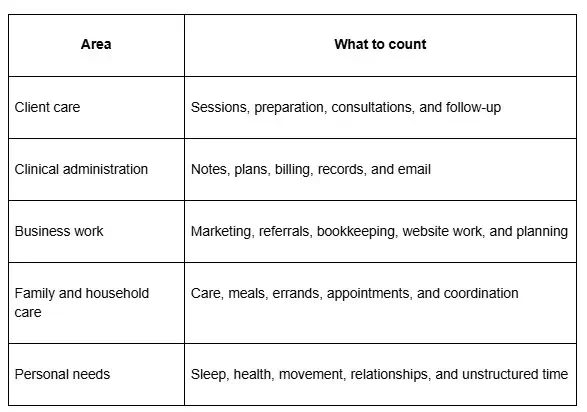
Do not use this audit to judge yourself.
Use it to see the full picture.
A calendar can look open while your capacity is already spoken for.
Find Your Revenue Floor
Your revenue floor is the minimum amount your practice needs each month after business expenses, taxes, unpaid time, cancellations, and the amount your household relies on.
Answer five questions.
What does the practice cost each month?
What amount does your household need from it?
What needs to be saved for taxes and time away?
How many attended sessions produce that amount at your current fee?
What happens when clients cancel or take breaks?
This is where vague financial anxiety starts becoming a plan.
Choose a Caseload Range
I would not give every therapist mother the same weekly client number.
Your client population, session intensity, fee, administrative support, family needs, and health all matter.
Choose three numbers.
Your minimum financially workable number
Your usual weekly number
The number where notes, patience, sleep, or family time begin to suffer
That third number deserves your attention.
Your body often notices your limit before your spreadsheet does.
Build Three Versions of Your Week
Create a usual week for stable periods.
Create a disrupted week for illness, care changes, or an urgent family need.
Create a recovery week for the period after leave, travel, illness, or an emotionally heavy stretch.
Decide in advance what stays and what moves.
This is not pessimism.
It is a plan built for real life.
Build a Private Practice Schedule That Can Bend
Group Sessions Into Clear Blocks
Scattered sessions can make an entire day feel like work.
Try placing sessions into defined blocks. Protect separate blocks for notes, billing, marketing, and family time.
Pay attention to energy, not only open hours.
Three spaces on a calendar do not always equal capacity for three more clients.
Create a Transition Between Work and Home
Research with psychotherapists points to the value of mentally stepping away from work during personal time.
Your transition can be simple.
Finish the final note. Take ten quiet minutes. Walk. Change rooms. Eat something.
Give your mind a signal that one role has ended.
Give Administrative Work Real Hours
Notes are work.
Billing is work.
Marketing is work.
Client email is work.
When these tasks do not have hours of their own, they move into nights and weekends.
Put them on the calendar before adding more sessions.
Set Communication Boundaries Early
Write down your office hours, response window, emergency instructions, cancellation policy, and scheduling process.
Private practitioners need to review local laws, licensing rules, professional ethics, and informed consent requirements because these differ by profession and location.
Clear policies do not make you less caring.
They make care more dependable.
Plan for Maternity Leave Before the Final Weeks
Maternity leave in private practice is both a family plan and a business plan.
Start with money. List personal expenses, practice expenses, taxes, software, insurance, office costs, and professional fees. Decide what must be covered during leave and create a savings target.
Then plan client care.
Think through communication timing, referrals, emergency information, record access, coverage, and documentation. The American Counseling Association advises private practitioners to prepare a plan for transferring clients and files if a clinician leaves or becomes unavailable.
Your plan needs to follow your profession’s ethics, insurer terms, licensing rules, and local laws.
A target return date can help, but leave room for it to change. Plan a return window when possible, then begin with fewer sessions and more administrative space.
The Maternity Leave Bundle for Therapists gives therapists scripts and planning tools for this season, so you are not writing every client message and business step from a blank page.
Make Support Specific
“Ask for help” is not a plan.
Name the task. Name who owns it. Name when it happens.
There is a difference between completing a household task after someone asks and owning the thinking behind it. Research on cognitive household labor separates planning from physical completion and connects the planning side with maternal well-being (Archives of Women’s Mental Health).
Ask who notices, plans, schedules, follows up, and carries the backup plan.
Use the same questions inside your business.
Paid support is not available to everyone. When it is, look at more than price.
Childcare, cleaning, bookkeeping, billing, meals, administrative help, and website support may return time or energy. Choose the task that repeatedly pushes work into hours you want to protect.
Keep Clinical and Business Support Separate
Clinical supervision or consultation supports client work.
Business support helps with fees, systems, marketing, boundaries, and planning.
SAMHSA has noted that continued training and clinical supervision can support care quality and reduce emotional exhaustion, burnout, and turnover in behavioral health settings.
Business questions need a place too.
The Private Practice Club for Therapists gives therapists a place to bring real questions, hear how others are handling the same season, and stop carrying every decision alone.

Build Income Around the Season You Are In
One-to-one therapy is one way to earn income. Teaching, supervision where permitted, workshops, writing, digital resources, courses, and memberships can also become part of a therapist’s business.
But every new income source adds planning, communication, technology, customer care, and marketing.
Do not add five offers because you are tired of seeing clients.
That is how one heavy job becomes six unfinished ones.
Choose one idea that fits your experience, audience, energy, and current season.
Sometimes the answer is not another offer. It is a clearer message and a steadier referral plan.
The Marketing for Therapists course walks through how to communicate your work and build referral relationships without turning every free hour into content creation.
Systems matter too.
Client onboarding, paperwork, scheduling, billing, referrals, and weekly planning do not need to be reinvented every time.
That is why I created the Private Practice Roadmap. Private practice is just a series of steps. When you know what comes next, you spend less energy holding the whole business in your head.
Redefine Success Every 90 Days
Your business goals should not ignore the life the business is meant to support.
Every 90 days, choose measures that show more than gross revenue. You might track weekly sessions, notes completed during work hours, evenings protected from work, revenue after expenses, or energy after your final session.
Then choose three priorities.
One for the business.
One for your family.
One for you.
You are allowed to build differently in different seasons.
A smaller caseload can be a smart decision. More care can be a smart decision. A pause can be a smart decision. A new offer can be a smart decision.
So can deciding that now is not the time to create one.
You are not behind.
You are building something real.
Your practice does not need to look impressive from the outside. It needs to work inside your actual life.
Frequently Asked Questions
Is work-life balance possible for therapist moms?
Yes, but it may not look like equal time for every role each day. A more useful goal is a practice with clear limits, realistic capacity, support, and room for changing family needs. Research connects work-family conflict and high workload with psychotherapist burnout, so the structure of the work matters.
How many clients should a therapist mom see each week?
There is no single number for every therapist mother. Your range depends on your fee, expenses, client population, session intensity, documentation, care, health, and other work. Start with your revenue floor, then watch the point where clinical quality, sleep, notes, or family time begin to suffer.
How should a therapist prepare for maternity leave?
Plan for personal and business expenses, client communication, referrals, records, emergency information, coverage, documentation, and a flexible return. Review the requirements of your licensing body, insurer, professional association, and practice location. ACA guidance also supports having a prepared client and record transfer plan.
How can I reduce guilt about working while raising children?
Ask what the guilt is trying to tell you. It may point to a boundary that needs attention, or it may come from pressure to meet an impossible standard of motherhood. Research has connected pressure to be a perfect mother with parental burnout, so guilt should be examined rather than automatically obeyed.
Should therapist mothers create courses, teach, or build membership income?
They can, but another income source still requires planning, communication, marketing, and maintenance. Pick one option that fits your skills and current season. Make sure it reduces pressure rather than quietly adding another job.