
$150K vs. $250K in Therapist Private Practice Income
I keep seeing private practice numbers fly across Instagram, YouTube, and TikTok.
One therapist says she earns $150,000 a year. Another says she earns $250,000. It is easy to assume the second therapist must be seeing ten or fifteen more clients every week.
But in the examples below, the practice earning close to $250,000 has only two more completed sessions per week. The larger change is the fee, supported by enough demand to keep the calendar steady.
So let’s look at the numbers without pretending there is one normal income for every therapist.
What Does Therapist Private Practice Income Actually Mean?
Before we compare $150,000 and $250,000, we need to name what those numbers represent.
In this article, we are calculating gross practice revenue. That is the money the practice brings in before business expenses and personal tax obligations are taken out. The IRS describes gross receipts as income received by a business, while net profit is what remains after business expenses are subtracted.
That distinction matters.
A therapist who bills $144,000 has not personally taken home $144,000. Practice costs still need to be paid. This article does not calculate those costs or offer tax advice. It asks one question. What combination of fee, sessions, and working weeks produces these gross revenue numbers?
Why therapist salary data can confuse the comparison
You may have seen the Bureau of Labor Statistics report that the median annual wage for marriage and family therapists was $63,780 in May 2024.
That number is useful for understanding employee wages. It is not a clean comparison with solo private practice revenue because the same BLS page states that its wage data do not include pay for self-employed workers.
Salary, gross revenue, business profit, and personal take-home pay are different numbers. Blending them creates a comparison that measures different things.
The Three Numbers Behind Therapist Private Practice Income
The math is simple enough to fit on one line.
Session fee × average completed sessions per week × working weeks per year = annual gross practice revenue
The hard part is choosing honest numbers.
Your session fee
For this calculation, the session fee is the amount billed for one 50-minute session.
If you keep reduced fee openings, use the average amount you collect per completed session. A listed fee of $225 does not tell the full story when several openings are billed at another amount.
Your average completed sessions each week
Use sessions that happen, not every space you hoped to fill.
A therapist may offer 24 openings but average 20 completed sessions after cancellations and slower seasons. Heard surveyed 1,950 mental health professionals and reported a median caseload of 18 clients per week for solo therapists. The findings were self-reported and should not set your personal target.
Your working weeks each year
The examples below use 48 working weeks.
That leaves four weeks away from sessions. Using 52 weeks may look better on paper, but it assumes a usual caseload every week of the year. Choose the number that reflects the year you plan to live.
The $150,000 Therapist Private Practice Income Example
Let’s start with a therapist earning around $150,000 in annual gross revenue.
The example from my original breakdown uses these numbers.

The calculation is straightforward.
$150 × 20 × 48 = $144,000
This does not equal exactly $150,000. It represents a practice in that general revenue range.
And honestly, this already takes real work.
Twenty clinical sessions do not create a 20-hour workweek. The Bureau of Labor Statistics lists recordkeeping and private practice business tasks among a therapist’s duties.
A therapist at this level may already have a good foundation. People are finding the practice. Referrals are coming from somewhere. The website or directory profile is doing at least part of its job.
But the therapist may still be sitting in the office thinking, “This is working, but will it keep working? ”
That is the difference between having a good month and trusting the pattern.
The $250,000 Therapist Private Practice Income Example
Now let’s look at the practice of earning close to $250,000.
The original example uses these numbers.
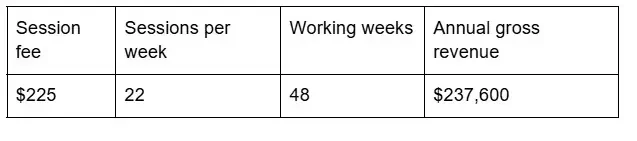
Here is the calculation.
$225 × 22 × 48 = $237,600
Again, this does not equal exactly $250,000. It represents a practice approaching that revenue range.
The therapist is completing two more sessions per week than the first example.
Not ten more. Two.
The session fee increased by $75, from $150 to $225. The number of working weeks stayed at 48.
This is the part I want therapists to see clearly. A large change in annual revenue does not always require a large change in weekly clinical volume.
It does require the higher fee to be supported by real demand. Twenty-two sessions at $225 only work when those sessions are booked and completed with enough regularity to make the average true.
$150K vs. $250K Side by Side
Here is the complete comparison.
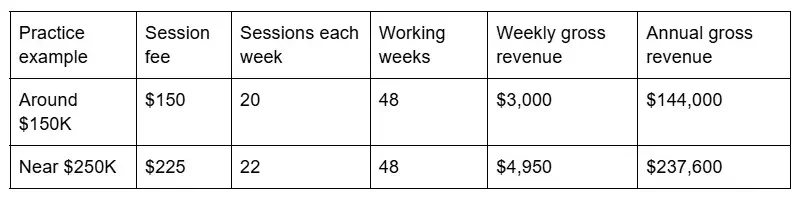
The second practice brings in $93,600 more and adds 96 sessions across the year. Most of the difference comes from applying the $75 fee increase across the full caseload.
The Therapist's Private Practice Income Math People Often Get Wrong
The formula is not difficult. The assumptions inside it are where things go sideways.
Assuming more money always means many more clients
When therapists want to earn more, the first idea is often to add sessions.
That can work mathematically. It may not work personally.
Psychotherapy carries demands that cannot be measured by counting 50-minute blocks. A systematic review of burnout and psychological well-being among psychotherapists linked well-being with several personal and work-related factors. It does not provide one perfect caseload number. It does remind us that capacity matters.
Looking at one session instead of one year
A $25 difference may look small for one appointment. Across 20 weekly sessions and 48 weeks, it equals $24,000 in gross annual revenue.
$25 × 20 × 48 = $24,000
A $50 difference across the same schedule equals $48,000.
The annual view makes the decision visible.
Counting scheduled openings instead of completed sessions
Use your average completed sessions, not every appointment space offered. Review several months, count completed sessions, and divide by the number of weeks.
Forgetting time away from sessions
A target built on 52 full weeks may quietly remove every vacation, sick day, and slower week. That is not a plan. It is a spreadsheet wearing a tiny fake mustache.
Calling every number income
This one causes the most confusion.
Gross revenue is the money the practice receives. Net profit remains after business expenses. The IRS explains that self-employed people determine net profit or loss by comparing business income with business expenses. When someone says, “I make $250,000,” ask whether they mean billed revenue, collected revenue, profit, or personal pay.
A Higher Session Fee Is Not the Whole Story
It would be easy to stop here and say the answer is simply to raise your fee.
That would be incomplete.
A $225 fee with six completed sessions per week does not produce the second example. The practice also needs enough people reaching out, booking, and staying long enough to support the weekly average.
This is where most therapists get stuck.
They work on the fee and the caseload as though they are separate. They are not.
People need to understand why your practice fits.
A potential client may hear your name from a doctor, therapist, school counselor, friend, search result, or directory. Your website and profile need to make the work easy to understand so that the person can recognize whether the practice may fit.
The BLS notes that therapists in private practice may need to market their businesses to prospective clients. In Heard’s 2026 report, referrals and online directories were among the most reported ways therapists said clients found them.
Stability comes from knowing which parts of your work keep bringing the right people back to your door.
A steady referral pattern changes the experience
At around $150,000, I often see therapists who have built something good but still feel uncertain about whether referrals will keep coming.
At the higher revenue level, the difference I notice most is consistency.
The therapist knows where inquiries tend to come from, keeps showing up there, and talks clearly about the people she helps. It is quieter work repeated long enough to become dependable.
What Accessibility Can Look Like Inside the Math
A higher standard fee does not automatically mean every client in the practice pays that amount.
When I reached this revenue level in my own practice, I kept four sliding scale openings for clients earning at or below minimum wage. I charged those clients what they earned for one hour of work.
That was my choice, not a rule for every practice. The point is that accessibility choices belong inside the math.
If several clients pay a reduced fee, use your true average collected fee when you calculate your projected revenue. That gives you a number you can plan around without pretending every session is billed at the highest rate.
How to Calculate Your Own Therapist Private Practice Income
The best numbers are your numbers.
Here is what I would do.
Start with the weekly caseload you can sustain
Do not begin with an annual target and force your calendar to carry it. Start with a clinical load that leaves room for notes, business work, family, and rest. There is no prize for choosing the largest number.
Use the fee you actually collect.
If your standard fee is $200 but your average collected fee is $178 because of reduced fee openings, use $178.
The calculation is only useful when the inputs are honest.
Pick a realistic number of working weeks.
Mark vacations, holidays, training, and family time before the year starts, asking for all of it.
Run more than one version.
Compare several versions. Keep the caseload at 18 and test three fees. Then keep the fee and compare 16, 18, and 20 sessions. You are not choosing your worth from a calculator. You are seeing how the parts affect one another.
Use the therapist income calculator
You can use my private practice resources to find tools that help you put your own fee, caseload, and working weeks into the equation.
Run the numbers before you add more sessions by default.
The result may show that your next move is a fee change. It may show that you need a steadier referral pattern. It may show that your current target asks too much from your calendar.
That clarity is the point.
What These Numbers Do Not Tell You
These examples are not instructions to charge $150 or $225.
They do not account for local demand, experience, reduced fee openings, business costs, or clinical focus. They also do not prove that a therapist earning more has built a better practice.
Heard’s 2026 survey reported a median 2025 revenue of $75,000 for solo practitioners, with wide differences across practices. That survey is a useful snapshot, not a standard every therapist needs to chase.
Revenue can tell you whether the math supports the business you are trying to build.
It cannot tell you whether your week feels good, whether your work still matters to you, or whether the practice fits your life.
Your practice should fit your life, not the other way around.

Your best income target starts with your numbers.
The difference between $144,000 and $237,600 looks enormous until you break it down.
The first uses a $150 fee and 20 weekly sessions. The second uses a $225 fee and 22 sessions. Both use 48 weeks. The second also needs enough steady demand to support those numbers.
You do not have to copy either example. You do need to know what your own numbers are asking of you.
Start with the free private practice resources and income planning tools. Put your real numbers into the calculation and see what changes.
And if the math shows you that the missing piece is a steadier referral plan, clearer communication, or support while you build, The Private Practice Club is where we work through those questions together.
You do not have to figure this out alone.
Frequently Asked Questions
How much do therapists make in private practice?
There is no single therapist's private practice income number. Fees, completed sessions, working weeks, business costs, location, and demand all change the result. The BLS wage figure for marriage and family therapists excludes self-employed workers, so employee salary data should not be treated as the normal revenue for a solo practice.
Is $150,000 in private practice gross revenue or take-home pay?
In this article, the $150,000 example refers to gross practice revenue. The exact calculation produces $144,000 before business expenses and personal tax obligations. The IRS separates business income from the expenses used to determine net profit, which is why gross revenue should not be described as personal take-home pay.
How many clients does a therapist need to see to earn around $150,000?
In Kelley’s example, a therapist bills $150 for 20 completed sessions per week across 48 working weeks. That produces $144,000 in annual gross revenue. A higher fee could require fewer sessions, while a lower fee would require more sessions or more working weeks to reach a similar total.
Can a solo therapist earn close to $250,000 without seeing 30 clients each week?
The second example shows how it can happen mathematically. A therapist billing $225 for 22 completed sessions per week across 48 weeks would produce $237,600 in gross revenue. The harder part is building enough steady demand to keep that average true without creating a weekly schedule that no longer fits the therapist’s capacity.
How do I calculate my therapist private practice income?
Multiply your average collected session fee by your average completed sessions per week, then multiply that number by your working weeks per year. Use completed sessions rather than available openings, and include reduced-fee sessions in your average. You can start with the Private Practice Pro resource library and run several versions before deciding what needs to change.