
I remember the first time I had to pick an EHR for private practice.
It felt like the least fun version of online shopping.
Instead of looking at chairs for the office or a cute lamp for the waiting room, I was staring at pricing pages, HIPAA language, billing tools, client portals, and words that made me want to close my laptop and go eat something crunchy.
And the whole time, the thought underneath was pretty simple.
I just need something that works.
That is what most therapists are looking for when they search for the best EHR for mental health private practice. Not the fanciest platform. Not the longest feature list. Not the one with the prettiest dashboard.
You need an EHR that helps you schedule clients, write notes, send forms, collect payment, handle billing, protect client information, and keep your practice from turning into a second unpaid job after dinner.
The short answer is this.
For most solo and small mental health private practices in 2026, my top recommendation is SimplePractice.
That does not mean it is perfect for every therapist.
It means that for most private practice therapists who want one reliable place for scheduling, notes, billing, telehealth, payments, forms, and client communication, SimplePractice is the option I would look at first.
And yes, that is an affiliate link. If you use it, I may receive a commission. I only recommend tools I would actually point therapists toward in real life, and SimplePractice is the EHR I have used in my own practice since 2016.
Now let’s go through what matters, what each major option costs, and how to choose without turning this into your new unpaid research project.
What an EHR needs to do in a therapy practice
An EHR is your electronic health record system.
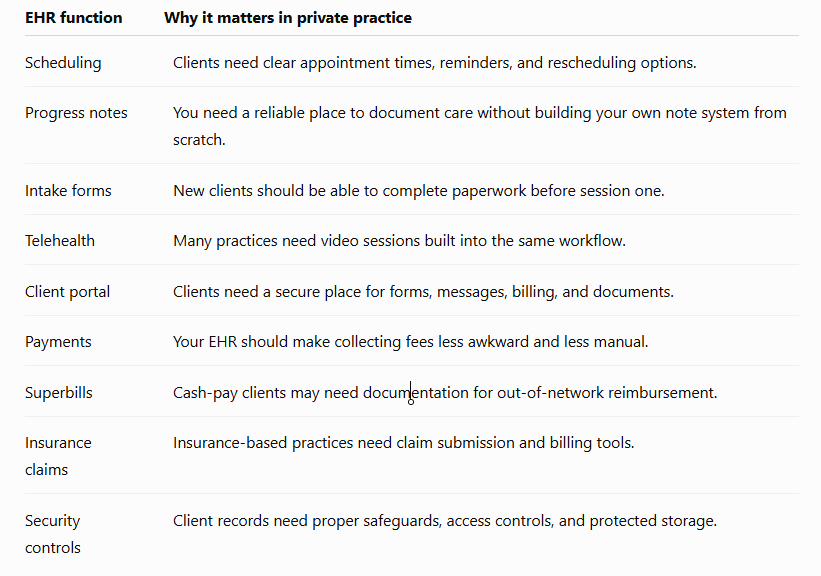
For a mental health private practice, that usually means one platform where you can manage client records, schedule appointments, write progress notes, send intake paperwork, collect payment, offer telehealth, create superbills, and handle insurance claims if you take insurance.
This matters because EHR use is now normal across health care. The Office of the National Coordinator for Health Information Technology reported that 95% of United States office-based physicians used any EHR in 2024, and 91% used a certified EHR.
Mental health has its own version of this shift. ONC also reported that more than two thirds of substance use and mental health treatment facilities used only an EHR in 2024.
But therapy practices are not tiny hospitals.
You do not need a giant medical system if you are a solo therapist seeing 18 clients a week.
You need something that fits the actual rhythm of your work.
A good mental health EHR should help you manage these pieces.
If you are in the United States, HIPAA matters here. HHS explains that the HIPAA Security Rule requires administrative, physical, and technical safeguards for electronic protected health information.
That means your EHR is not just a convenience tool.
It is part of how you protect client information.
Why mental health practices need a different kind of EHR
Mental health documentation is not the same as documentation in a general medical office.
A therapist may need treatment plans, progress notes, diagnosis tools, consent forms, release forms, crisis plans, superbills, telehealth links, and secure communication.
A therapist may also need privacy settings that make sense for sensitive records.
This is why I do not recommend choosing an EHR only because it is popular in healthcare.
A platform can be great for a medical clinic and still feel clunky for a therapist.
The better question is this.
Does this EHR support the way a therapy practice actually runs?
For most private practice therapists, the right EHR should make daily admin feel lighter. It should not ask you to become a part-time tech support person with a caseload.
Best overall EHR for mental health private practice in 2026
My top pick is SimplePractice.
SimplePractice is built for health and wellness professionals, and its platform includes tools for scheduling, documentation, telehealth, billing, payments, insurance, client communication, and a client portal.
The reason I like SimplePractice for most therapists is not that it is the cheapest.
It is because it keeps the main parts of private practice in one place.
That matters more than people realize when they are starting.
When you are new, you are already thinking about your niche, your fee, your first client call, your website, your Psychology Today profile, your office setup, your paperwork, and the tiny voice in your head whispering, Am I doing this right?
You do not need your EHR to become another confusing project.
You need it to hold the basics.
SimplePractice pricing in 2026
SimplePractice currently lists three main monthly plans on its official pricing page.
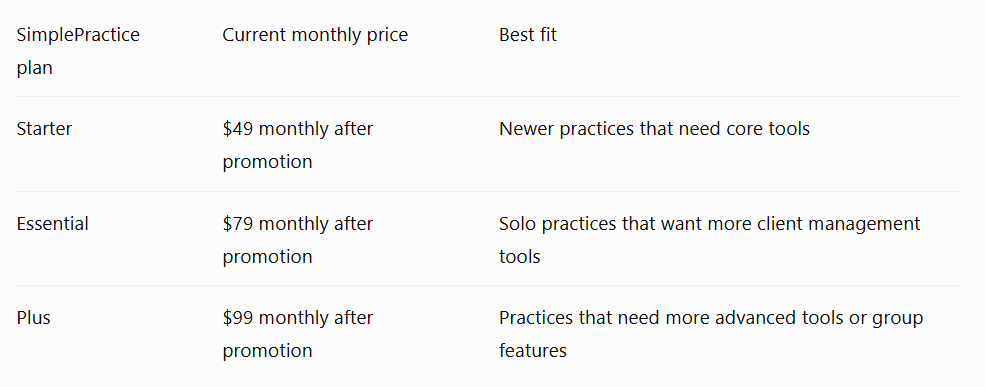
SimplePractice also lists paid add-ons on its pricing page, including Care Aide, Note Taker, and ePrescribe, so the monthly cost may be higher if you add those tools.
This is where therapists sometimes get tripped up.
The plan price is not always the full cost.
You also want to check payment processing fees, insurance claim fees, telehealth needs, reminder costs, AI note tools, and any extra features you may need later.
The least expensive plan is not always the least expensive choice if it costs you hours every month.
SimplePractice and HIPAA
SimplePractice states in its support center that it is HIPAA compliant and HITRUST certified.
It also provides a Business Associate Agreement, which matters because HHS explains that business associate contracts should describe how a vendor may use protected health information, what safeguards are required, and what happens when the agreement ends.
That said, using a HIPAA-compliant platform does not remove your responsibility as a therapist.
You still need your own policies, your own privacy practices, your own record-keeping decisions, and your own understanding of what applies in your location.
An EHR can support compliance.
It cannot be your entire compliance plan.
Tiny, annoying sentence. Big difference.
Best EHR options for mental health private practice in 2026
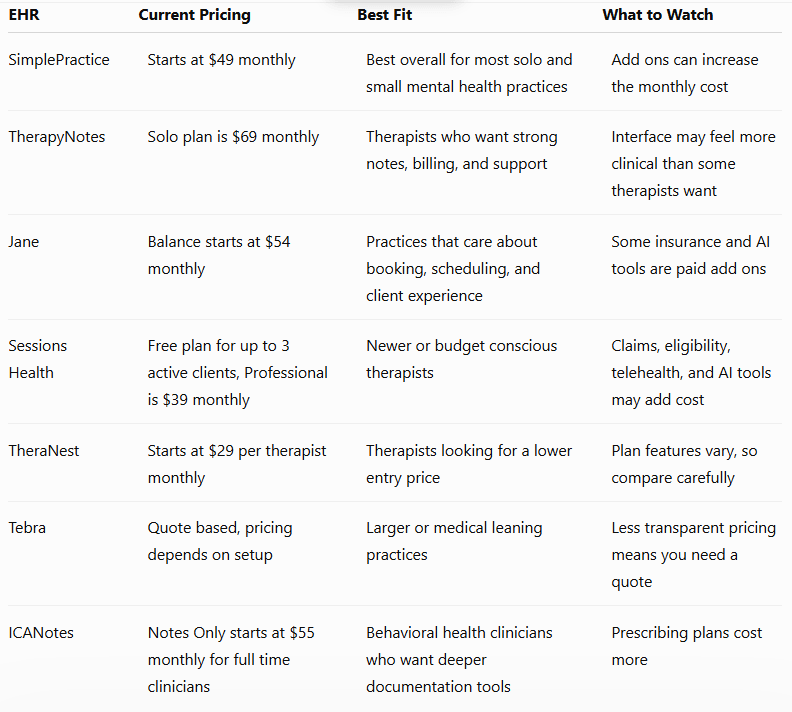
Here is the comparison I would use if I were starting from zero and trying to choose without overthinking it.
TherapyNotes
TherapyNotes is a strong option for therapists who want a mental health-focused system with scheduling, notes, billing, and practice management tools.
TherapyNotes lists its solo plan at $69 monthly. Its group plan is $79 monthly for the first clinician and $50 monthly for each added clinician, with unlimited non-clinical users.
I would look at TherapyNotes if billing and documentation are your main concerns.
It may feel a little more traditional than SimplePractice, but that can be a good thing for therapists who want a structured documentation flow.
Jane
Jane is a clean, polished option that works well for clinics and wellness practices that care a lot about booking and client experience.
Jane currently lists Balance at $54 monthly, Practice at $79 monthly, and Thrive at $99 monthly.
I would look at Jane if your practice includes multiple services, group appointments, or a clinic-style schedule.
For a straightforward solo therapy practice, it may be more than you need.
Not bad. Just maybe more room than you need in the house.
Sessions Health
Sessions Health is one of the most budget-friendly options on this list.
It has a free plan for up to 3 active clients, and its Professional plan is listed at $39 monthly. Sessions Health also lists paid add-ons for claims, eligibility reports, telehealth, and AI Assist.
I would look at Sessions Health if you are just starting out, keeping costs low, or building slowly.
This is the kind of option that can make sense when your practice is not full yet and you are trying to make smart choices without adding big monthly expenses too early.
TheraNest
TheraNest by Ensora Health is a mental health EHR and practice management platform with scheduling, notes, billing, telehealth, and client portal tools.
Ensora Health lists TheraNest plans starting at $29 per therapist monthly.
I would look at TheraNest if price were a major factor and you wanted a therapy-focused system.
Just read the plan details carefully. Lower starting prices can be helpful, but the real question is whether the plan includes what you actually need.
Tebra
Tebra is a broader private practice platform that includes EHR, billing, payments, patient experience tools, and growth tools.
Tebra says pricing depends on provider type, specialty workflows, claim volume, and the setup your practice needs.
I would not usually make Tebra the first stop for a solo therapist who wants a simple private practice EHR.
I would look at it if you are running a larger practice, need more medical practice tools, or want a more involved billing and practice management setup.
ICANotes
ICANotes is built for behavioral health and lists itself as an EHR for mental health and behavioral health clinicians.
Its pricing page lists full-time clinician plans starting at $55 monthly for Notes Only, $75 monthly for Non-Prescribing, and $213 monthly for Prescribing, with an activation fee for prescribing plans.
I would look at ICANotes if documentation is your biggest pain point, especially if your work requires more structured behavioral health notes or prescribing tools.
For many solo therapists, it may be more documentation-heavy than needed.
For some clinicians, that is exactly the point.
How to choose the right EHR without overthinking it
This is where most therapists get stuck.
They compare ten tools, open twenty tabs, read a few Reddit threads, ask three Facebook groups, and somehow feel less clear than when they started.
So here is what I would do.
Choose based on the practice you are actually building, not the imaginary version of your practice five years from now.
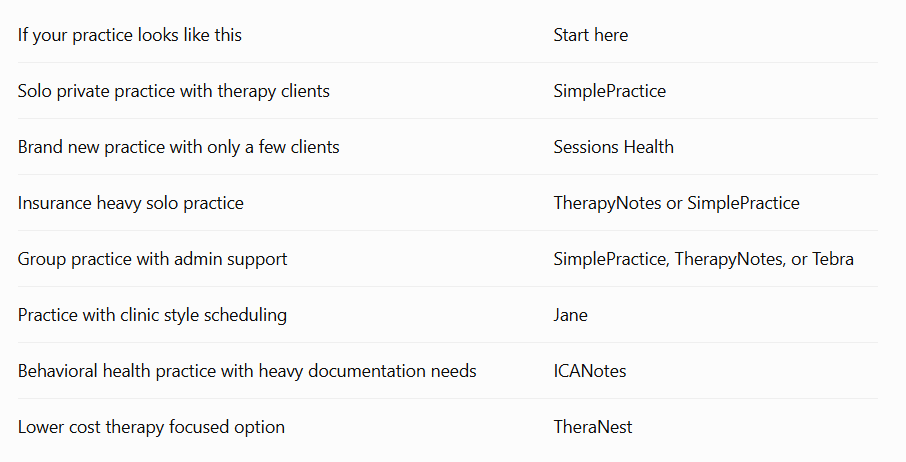
If you are a solo therapist starting a private practice and you want the simplest first answer, I would start with SimplePractice.
If your budget is tight and your caseload is still small, Sessions Health is worth a look.
If insurance billing is the thing you are most worried about, compare SimplePractice and TherapyNotes closely.
If documentation is the part that makes you want to lie down on the floor, look at ICANotes.
Clarity beats perfection here.
You are not marrying your EHR.
You are choosing the system that will carry your practice through the season you are in.
What to check before you sign up
Before you choose an EHR, check these items.
Business Associate Agreement
HHS says business associate contracts should define permitted uses of protected health information and vendor safeguards.
Data export
You need to know how to get your records out if you leave.
Record retention
Your records still need to follow your legal and ethical duties.
Telehealth tools
You need to know whether video is included or paid separately.
Payment fees
Processing fees can change your real monthly cost.
Claims fees
Insurance billing can add per claim costs.
Reminder fees
Text reminders may not be included in every plan.
AI tools
You need to know what data is used and how it is protected.
Group practice permissions
Owners, admins, and clinicians need the right access levels.
Client portal experience
Clients should be able to use it without needing a tutorial from you.
The Business Associate Agreement is especially worth reading. HHS explains that a business associate contract may include language about permitted uses, safeguards, reporting, subcontractors, and returning or destroying protected health information.
This is not the fun part.
But it is the part that protects you from assuming a vendor relationship is safer than it actually is.
What most therapists forget to calculate
Monthly pricing is only one piece.
The real cost of an EHR includes the time it saves or steals.
A $39 monthly EHR that takes you three extra hours a month to fight with is not really cheaper.
A $99 monthly EHR that helps you send forms, collect payments, write notes, and keep your week cleaner may be worth it.
Here is what I would calculate before choosing.
Monthly subscription - What is the regular price after promotions?
Payment processing - What percentage or fee is taken from card payments?
Claims - Is there a per claim cost?
Eligibility checks - Are these included or paid separately?
Telehealth - Is video included in the plan I need?
AI notes - Is this included or an extra monthly cost?
ePrescribe - Is this needed and what does it cost?
Migration - How hard will it be to move client data?
Training time - How long will it take to feel comfortable?
Admin time - Does the system reduce or add weekly admin work?
This is the part people skip.
They look at the monthly price and forget to price their own time.
But your time is part of your practice of math.
Especially if you are building this while parenting, working another job, paying loans, or trying to have a life outside of session notes.
Your EHR should support the practice you are building.
It should not become the reason you are finishing paperwork at 10:43 p.m. with one eye open.
Final thoughts
The best EHR for mental health private practice in 2026 is the one that fits your current practice, protects your client information, supports your workflow, and saves more time than it costs.
For most solo and small mental health private practices, I would choose SimplePractice first.
For a newer practice with a smaller caseload, I would compare Sessions Health.
For an insurance-heavy practice, I would compare SimplePractice and TherapyNotes.
For deeper behavioral health documentation, I would look at ICANotes.
And for a larger practice with more moving parts, I would look at Tebra.
You do not need to pick perfectly.
You need to pick thoughtfully.
And then you need to get back to building the practice you actually want.
FAQ
What is the best EHR for a solo therapist in private practice?
For most solo therapists, SimplePractice is the best first choice because it includes common private practice tools like scheduling, documentation, billing, telehealth, payments, insurance tools, and a client portal. If cost is your biggest concern, Sessions Health is also worth comparing because it offers a free plan for up to 3 active clients and a Professional plan at $39 monthly.
Is SimplePractice HIPAA compliant?
SimplePractice states that it is HIPAA compliant and HITRUST certified. It also provides a Business Associate Agreement, which matters because HHS says business associate contracts help define how vendors may use and protect health information.
How much should a therapist expect to pay for an EHR in 2026?
Many therapy EHRs fall somewhere between about $39 and $99 monthly for common solo practice plans, based on current public pricing from Sessions Health, SimplePractice, TherapyNotes, andJane. The real cost can be higher if you add telehealth, claims, payment processing, AI notes, eligibility checks, or prescribing tools.
Do cash-pay therapists need an EHR?
Cash-pay therapists do not always need insurance claim tools, but they still need a secure way to manage scheduling, forms, payments, documentation, superbills, and client records. HHS explains that the HIPAA Security Rule applies to electronic protected health information, so secure record handling still matters even if you do not bill insurance.
What should I check before switching EHRs?
Before switching, check the vendor’s Business Associate Agreement, data export process, pricing after promotions, payment fees, claims fees, telehealth costs, AI data policies, and client portal experience. HHS notes that business associate contracts can address permitted uses of protected health information, safeguards, breach reporting, subcontractors, and return or destruction of protected health information, so this is worth reviewing before you move your records.