
Build Referral Trust: Why Therapist Updates Matter
I remember sitting in meetings as the marketing director of a large adolescent treatment program and hearing the same question from referral partners.
“I sent someone your way. Did they ever get connected? ”
Sometimes we could answer with the client’s permission. Sometimes we could not. And sometimes nobody had created a process for answering at all.
The referral may have been handled well, but the person who made it had no way to know what happened next.
This is where therapist referral updates matter.
A referral update is not a clinical summary. It is a brief communication that closes the loop when you are permitted to send it.
Done well, it tells a referral partner, “I received this. I handled it with care. I also protected the client’s privacy.”
A therapist referral update should communicate care without communicating more than the client permitted.
This article offers general educational information. Privacy law, licensing rules, professional codes, and practice policies vary. Check the rules that apply to your license, location, setting, and client before sharing protected information.
What Are Therapist Referral Updates?
Therapist referral updates are brief communications sent to an appropriate referral source about the status of a referral.
A psychiatrist treating the same client has a different role from a school counselor, attorney, coach, clergy member, employer, former therapist, or friend. Making an introduction does not automatically give someone the right to receive information afterward.
Client-Specific Updates
A client-specific update may confirm that the referral was received, contact was attempted, an appointment was scheduled, services began, or care ended.
Even a small status detail can reveal protected information. Saying, “Yes, they started therapy with me,” confirms that the person is receiving mental health care from your practice.
The permission question comes before the wording question.
General Practice Updates
A general practice update does not identify a client.
You might tell a referral partner that you have openings, now work with college students, offer virtual sessions, or use a new referral form.
These messages keep professional contacts informed without confirming that a particular person contacted you.
Referral Updates Are Not Therapy Reports
Most referral sources do not need session details, trauma history, progress notes, or a full diagnosis. They may only need to know whether the referral was received and handled.
Why Referral Updates Build Professional Trust
When I was responsible for referral relationships, I learned that trust was built through small moments.
Did we respond, explain the next step, keep our word, and protect the client?
No single email created a referral relationship. The pattern did.
They close the communication loop
“Closing the referral loop” describes a system that tracks whether a referral was received, completed, and communicated back to the referring professional.
In one ambulatory care quality project, referrals closed on time rose from 40 percent to 70 percent after the team changed its referral management and communication process, according to the study indexed by PubMed.
That study was not about private practice therapy, so it does not prove that referral emails will fill a caseload. It does show the value of giving someone responsibility for the next step.
They Show That You Follow Through
A quick response tells referral partners that their message did not disappear into an inbox. You need a process, not a report on every detail.
They Respect the Trust Already Given
A referral is an act of professional trust.
Someone is putting your name in front of a client, patient, student, family, or colleague. The best response is gratitude, not a request for more referrals.
“Thank you for thinking of me. I will handle this carefully.”
Privacy Comes Before Referral Marketing
The part people skip is confirming whether the update should be sent.
Before sharing client-specific information, ask four questions.
Who is receiving the message?
What role do they have in the client’s care?
What information will be shared?
What legal, ethical, and client permission basis allows the disclosure?
A Referral Does Not Erase Confidentiality
The 2026 AAMFT Code of Ethics says marriage and family therapists should not share confidential information with colleagues or referral sources when it could reasonably identify the client unless written authorization has been obtained.
That standard may be tighter than what someone assumes HIPAA allows. License rules, local law, employment setting, client requests, and practice policy may add more limits.
Counselors should also confirm the current ACA standard. As of June 2026, the American Counseling Association says its revised Code of Ethics is expected in Fall 2026.
Treatment Communication May Be Permitted Under HIPAA
For covered providers in the United States, the HHS treatment disclosure guidance explains that protected health information may often be shared between healthcare providers for treatment without a separate authorization.
Care coordination and consultation between providers can fall within treatment, but that does not create a blank check. Confirm the recipient’s role and check for stricter rules or agreed client restrictions.
Consent and Authorization Are Not the Same
A client may say, “Yes, you can talk to my doctor,” but that conversation may not satisfy every requirement.
According to HHS guidance on consent and authorization, a HIPAA authorization is a detailed document that identifies the information, the person permitted to disclose it, the recipient, and an expiration date or event.
The Minimum Necessary Rule Has an exception
The HHS minimum necessary guidance explains that the HIPAA minimum necessary standard generally does not apply to disclosures to or requests by a healthcare provider for treatment.
That exception does not mean every detail belongs in an update. My own practice rule is simple.
Share the smallest amount that serves the agreed purpose.
Psychotherapy Notes Receive Added Protection
With limited exceptions, HHS says psychotherapy notes require client authorization before disclosure, including many disclosures to another provider for treatment.
A referral update almost never requires psychotherapy notes.
Substance Use Disorder Records May Follow Added Rules
Some substance use disorder records are protected by 42 CFR Part 2.
HHS states that compliance with the 2024 Part 2 Final Rule was required by February 16, 2026. Do not assume that a standard therapy release covers every Part 2 situation.
School Referrals May Involve FERPA
School records often follow a different privacy framework.
The joint HHS and Department of Education guidance explains that many student health and counseling records maintained by schools are governed by FERPA rather than HIPAA.
Both sides need to know which rule covers the records they hold and what consent is required.
When Should a Therapist Send a Referral Update?
There is no single schedule that fits every practice. Here is what I would do.
After Receiving a Professional Referral
I would acknowledge the referral within one business day when possible.
The message can stay general.
Thank you for thinking of my practice. I received your referral and will follow my usual intake process. I will protect the person’s privacy and can share an update only when I have permission or another valid basis to do so.
This confirms receipt without confirming that the person contacted you, scheduled, or entered treatment.
After Contact or Scheduling
Send a client-specific status update only after confirming the disclosure is permitted. Even “They are scheduled for Tuesday” is health information. When authorization is required, check the recipient, scope, and expiration.
During Coordinated Care
When the referral partner is treating the same client, ask one question.
What does this provider need to know to support the client’s treatment?
When You Cannot Accept the Referral
State that you cannot accept the referral and offer another resource when you have one.
When No Update Should Be Sent
Do not send client-specific information when the recipient’s role is unclear, permission is missing, authorization has expired, the client objected, or the information is unrelated to care.
A slower, correct response is better than a disclosure you cannot take back.
What Should a Referral Update Include?
A useful therapist referral update can be short.
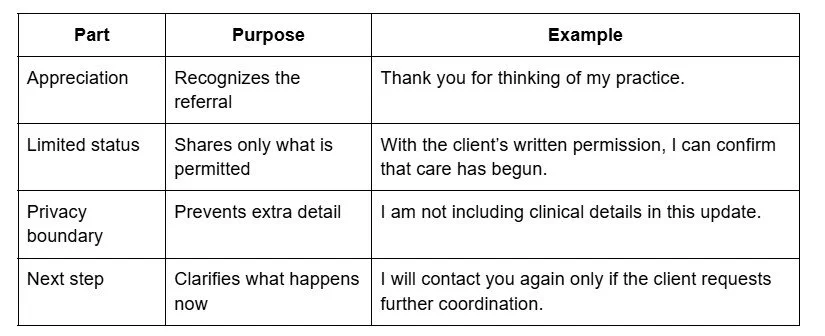
The part people skip is the privacy boundary. Without it, a short update can slowly become a clinical report nobody planned to create.
Therapist Referral Update Scripts
These scripts are starting points, not substitutes for your own legal and ethical review.
Referral Received Acknowledgment
Thank you for thinking of my practice and sending this referral. I received your message and will follow my normal intake process. To protect privacy, I cannot confirm whether someone contacts or begins services unless I have permission or another valid basis to share that information.
Client Scheduled Update
With the client’s written authorization, I can confirm that an initial appointment has been scheduled. I am keeping this update limited to the status of the referral. Thank you for helping connect the client with support.
Unable to Accept the Referral
Thank you for thinking of me. I am not able to accept this referral at this time. I have included two other resources that may be worth contacting. Availability can change, so the person will need to confirm openings directly.
School Counselor or Community Partner Update
Thank you for connecting this family with my practice. I can confirm that I received the referral. I cannot share whether the student or family contacted me unless the proper written permission is in place. I am grateful that you thought of me.
Thank You After a Referral
Thank you for continuing to think of my practice. I cannot confirm anyone’s client status in this message, but I want you to know that I value the trust behind every referral.
How to Build a Simple Referral Tracking System
You do not need a spreadsheet with seventeen tabs. You need a process you will use.
Ask About Referral Communication During Intake
When a client names a referral source, ask whether that person is involved in care, what may be shared, what must stay private, and how future communication should be handled.
Match the conversation with the authorization or documentation your setting requires.
Track the Permission, Not Just the Referral
Record the referral source, the source’s role, permission status, approved information, expiration date, communication method, and date of each update.
Keep marketing contact records separate from the clinical record when your policy requires it.
Use Decision Points
Build the process around referral received, intake scheduled, services started, referral declined, care coordination requested, and services ended.
At each point, ask whether an update is permitted and useful.
Use an approved communication channel.
The HHS guidance on electronic provider communication says covered providers may exchange protected health information electronically for treatment when reasonable safeguards are used.
Check the recipient, use systems approved by your practice, and limit what appears in subject lines. Secure technology does not make an unnecessary disclosure appropriate.
Document What You Shared
Record the date, recipient, method, purpose, information shared, and the permission or other basis you relied on.
HIPAA does not require documentation of every oral treatment disclosure, according to HHS guidance. Your professional rules, payer contracts, employer, or practice policy may still require it.
Referral Follow-Up Mistakes That Damage Trust
Sharing Information to Be Polite
Politeness is not permission.
You can thank someone without confirming that a person became your client.
Treating the Referral as Automatic Consent
A person can recommend your name without having a right to receive information afterward.
The introduction and the disclosure are separate events.
Sending Too Much Detail
Ask what the recipient needs for the agreed purpose. Most referral updates can do their job without diagnoses, session quotes, treatment goals, or family history.
Failing to Confirm the Recipient
One wrong email address can turn a thoughtful update into a privacy incident.
Slow down long enough to check.
Turning Gratitude Into a Referral Request
“Thanks for the referral. Send more people” is not gratitude.
Let the thank-you stand on its own.

The Referral Relationship Is Bigger Than One Referral
The strongest referral relationships I built did not come from one perfect networking email.
They came from being dependable over time.
I answered messages, followed the process I promised, sent useful practice updates, thanked people, and referred back when someone else was the better fit.
I did not treat every professional conversation like a transaction.
You do not build referral trust by proving that you are the smartest person in the room. You build it by being thoughtful, clear, responsive, and careful.
You do not need perfection. You need a process.
Your Next Step
Start with one referral source and one update template.
Review your release form. Decide what you can acknowledge without client-specific information. Write the version you will use when permission is in place, then add it to your intake process.
Small steps add up to big changes.
The Networking for Therapists resource can help you build referral relationships with more clarity. Marketing for Therapists goes deeper into what to say, where to build professional connections, and how to create a referral process that feels like you.
And if you want Kelley in your corner while you put these steps into practice, The Private Practice Club brings therapists together for live support, practical resources, and real conversations about what comes next.
You do not have to figure this out alone.
Frequently Asked Questions
Do Therapists Need Client Permission to Update a Referral Source?
It depends on the recipient, purpose, governing law, professional code, and information being shared. HIPAA may permit some treatment communication between providers without separate authorization, while the AAMFT Code of Ethics requires written authorization before sharing identifying confidential information with referral sources. Check every rule that applies rather than relying on HIPAA alone.
What Can a Therapist Tell a Referring Provider?
A therapist may be able to share limited information that serves treatment or care coordination when the communication is permitted. That might include confirmation that care began, scheduling status, or information tied to the agreed coordination purpose. Psychotherapy notes receive added protection under HHS guidance and are rarely needed for a referral update.
How Soon Should a Therapist Respond to a Referral Source?
There is no universal deadline. I would aim to acknowledge a professional referral within one business day when possible, even if the message only confirms receipt and explains the privacy boundary. A prompt acknowledgment is different from a client-specific update, which should wait until you confirm that sharing it is permitted.
Can a Therapist Tell a Referral Source That the Client Never Scheduled?
That statement confirms that the person contacted or did not enter the practice, which can still reveal protected information. Share it only when you have confirmed the proper legal, ethical, and client permission basis. Without that basis, send a general message that explains your privacy policy without confirming the person’s status.
How Can Therapists Track Referrals Without Risking Client Privacy?
Use a limited-access system that records the referral source, source role, permission status, approved scope, expiration date, communication method, and update history. Keep the amount of information small and follow your recordkeeping policy. The goal is to make the next right step obvious.